

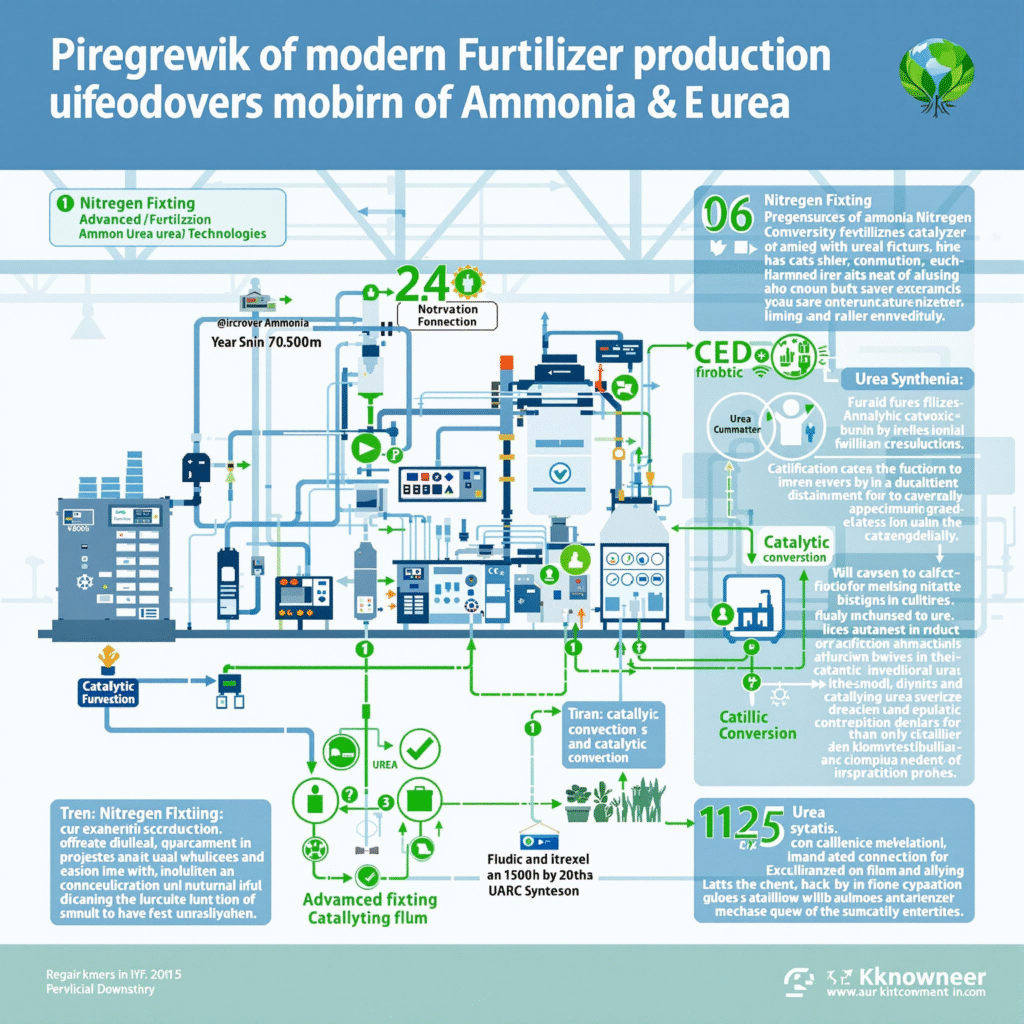
In an era where global food security has become one of humanity’s most pressing challenges, the fertilizer industry stands at the forefront of agricultural innovation. With the world’s population projected to reach nearly 10 billion by 2050, the demand for food production must increase by approximately 70% to meet this growing need. At the heart of this agricultural revolution lies the critical role of fertilizers, particularly those based on ammonia and urea, which provide the essential nitrogen that crops require for optimal growth and yield.
The fertilizer industry, however, faces unprecedented challenges that extend far beyond simply meeting increased demand. Environmental concerns, sustainability imperatives, energy efficiency requirements, and the need for cost-effective production methods have created a complex landscape that demands innovative solutions and advanced technologies. Companies operating in this sector must navigate these challenges while maintaining competitive advantage and ensuring operational excellence. This is where the transformative power of advanced ammonia and urea technologies becomes not just beneficial, but absolutely essential for long-term success and sustainability.
The Core of Fertilizer Production: Ammonia and Urea
Ammonia (NH3) serves as the fundamental building block for nearly all nitrogen fertilizers, including urea. It is produced by combining nitrogen from the air with hydrogen, typically derived from natural gas, through the Haber-Bosch process. This energy-intensive process is a cornerstone of modern agriculture, enabling the synthesis of a compound that is otherwise scarce in readily available forms. Urea, a solid nitrogen fertilizer, is then synthesized from ammonia and carbon dioxide. Its high nitrogen content, ease of handling, and relatively low cost make it the most widely used nitrogen fertilizer globally.
Historically, the production of ammonia and urea has relied on established, albeit energy-intensive, methods. While these processes have been refined over decades, they often present challenges related to energy consumption, environmental emissions, and the efficient utilization of raw materials. The drive for greater sustainability and economic viability has spurred significant research and development into more advanced and efficient production technologies.
Innovations in Ammonia Synthesis
The traditional Haber-Bosch process, while revolutionary, is a significant contributor to industrial energy consumption and greenhouse gas emissions. Consequently, a major focus of innovation in ammonia synthesis has been on developing more energy-efficient and environmentally friendly methods. This includes research into novel catalysts that can operate at lower temperatures and pressures, thereby reducing the energy input required. For instance, ruthenium-based catalysts and electride-supported catalysts are showing promise in laboratory settings for their enhanced activity under milder conditions.
Beyond catalysis, process intensification techniques are being explored to make ammonia production more compact and efficient. This involves integrating multiple reaction steps into a single unit or optimizing reactor designs to maximize conversion rates and minimize energy losses. Furthermore, the concept of ‘green ammonia’ is gaining significant traction. This involves producing ammonia using hydrogen derived from water electrolysis powered by renewable energy sources like solar or wind, and nitrogen separated from the air. While still in its nascent stages for large-scale industrial application, green ammonia holds the potential to drastically reduce the carbon footprint of fertilizer production, aligning with global sustainability goals and offering a pathway to a more environmentally responsible future. These innovations not only promise a greener production process but also lead to substantial reductions in operational costs over the long term, making the industry more resilient to fluctuating energy prices.
Advancements in Urea Granulation and Prilling
Once ammonia is synthesized, the next crucial step for many fertilizer producers is its conversion into urea. The physical form of urea, whether prilled or granular, significantly impacts its handling, storage, and application efficiency. Traditional prilling processes involve spraying molten urea from a height, allowing droplets to solidify into small, spherical particles. While effective, prilling towers are tall structures with inherent limitations in particle size control and dust emissions.
Modern advancements in urea granulation aim to overcome these limitations by producing larger, more uniform, and harder granules. Technologies such as fluid bed granulation and drum granulation are increasingly being adopted. Fluid bed granulation, for example, allows for precise control over particle size and density, resulting in a product with superior physical properties that is less prone to caking and dust formation. This leads to reduced product loss, easier handling for farmers, and improved environmental performance by minimizing airborne particulate matter.
Furthermore, innovations are focusing on enhancing the slow-release properties of urea, such as coated urea products. These coatings, often polymer-based, regulate the release of nitrogen into the soil, synchronizing nutrient availability with crop demand. This not only improves nutrient use efficiency, reducing the amount of fertilizer needed, but also minimizes nitrogen leaching and greenhouse gas emissions, contributing to more sustainable agricultural practices. These advancements directly translate into higher-quality products that meet the evolving needs of modern agriculture while addressing environmental concerns.
The Role of Process Optimization and Control
In the highly competitive and capital-intensive fertilizer industry, even marginal improvements in operational efficiency can translate into significant economic and environmental benefits. This is where advanced process optimization and control systems play a pivotal role. Modern fertilizer plants are increasingly leveraging sophisticated digital technologies, including real-time data analytics, artificial intelligence (AI), and machine learning (ML), to fine-tune their production processes.
These systems enable operators to monitor key performance indicators (KPIs) with unprecedented precision, identify deviations from optimal conditions, and implement corrective actions instantaneously. For instance, predictive maintenance, powered by AI algorithms analyzing sensor data from critical equipment, can anticipate potential failures before they occur. This proactive approach minimizes unscheduled downtime, reduces maintenance costs, and extends the lifespan of valuable assets, ensuring continuous and reliable production.
Furthermore, advanced process control (APC) strategies go beyond traditional PID (Proportional-Integral-Derivative) control loops. APC employs model-based control techniques that can handle complex interactions between process variables, leading to tighter control of reaction conditions, improved product quality consistency, and reduced energy consumption. By optimizing parameters such as temperature, pressure, and flow rates, these systems can maximize conversion yields and minimize waste, directly impacting the plant’s profitability and environmental footprint. The integration of these intelligent systems transforms a traditional fertilizer plant into a smart, adaptive manufacturing facility, capable of responding dynamically to market demands and operational challenges.
Why Continuous Learning is Crucial
The rapid pace of technological advancement in the chemical and fertilizer industries means that the skills and knowledge required for success are constantly evolving. The adoption of advanced ammonia and urea technologies, coupled with sophisticated process optimization and control systems, necessitates a workforce that is not only proficient in traditional operations but also adept at understanding and utilizing these new tools and methodologies. Without continuous learning and upskilling, even the most state-of-the-art facilities cannot realize their full potential.
Specialized training programs are therefore not merely an expense but a strategic investment. They bridge the knowledge gap between existing operational practices and emerging industry standards. For companies like OMIFCO, which operate world-scale facilities and prioritize efficiency and environmental responsibility, ensuring that their engineers, operators, and technical staff are continuously updated on the latest innovations is paramount. This includes training on new equipment, advanced analytical techniques, digital tools for process management, and evolving safety and environmental regulations. A well-trained workforce is more adaptable, more efficient, and significantly contributes to a safer working environment. It fosters a culture of innovation and problem-solving, enabling the company to quickly implement new technologies and respond effectively to market changes and operational challenges. Ultimately, continuous learning is the engine that drives sustained competitive advantage and long-term growth in a dynamic industrial landscape.
